
MANUFACTURING
 Stainless Steel
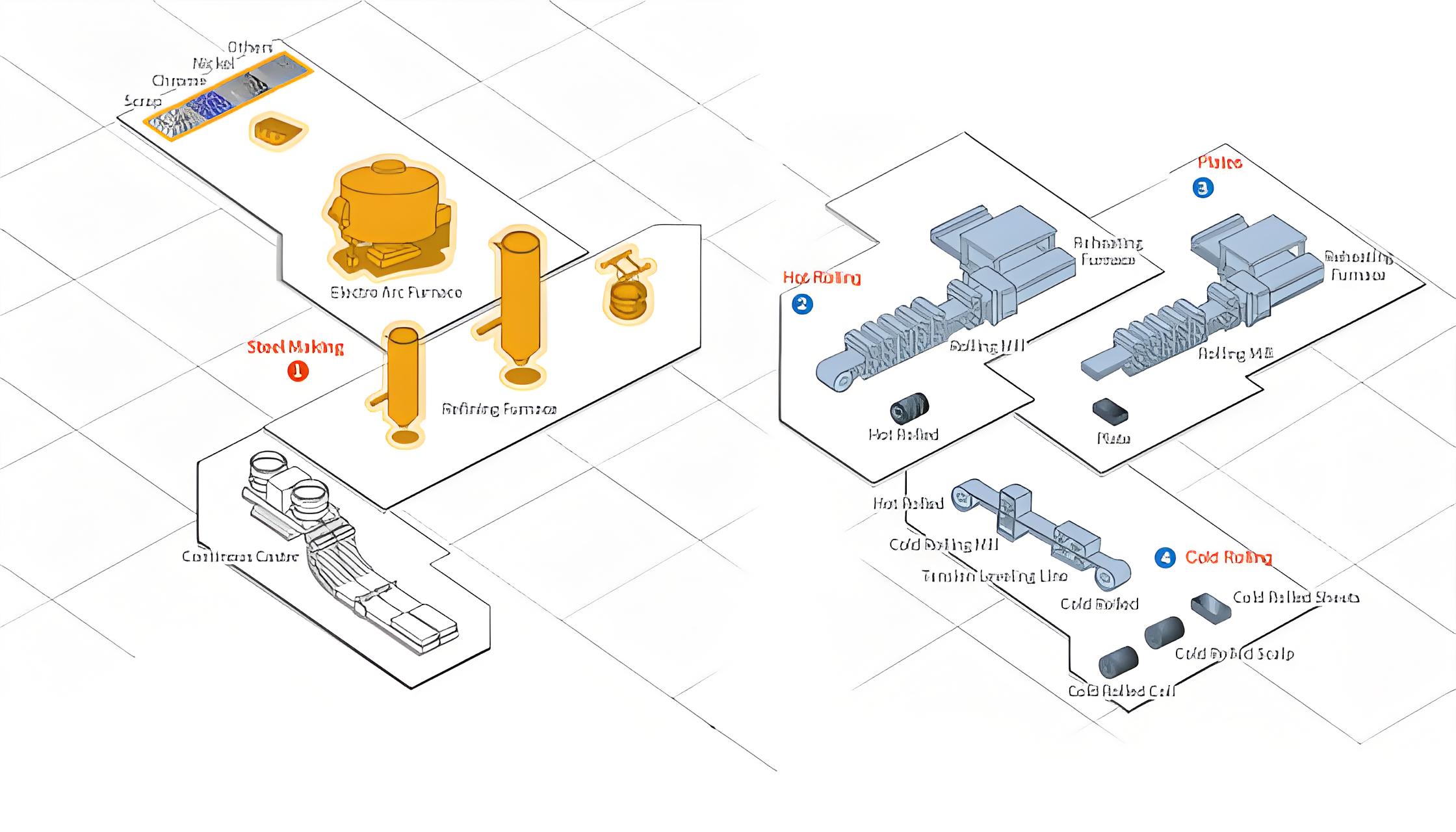
1. Steel Making: Steelmaking has the greatest impact on the quality and cost of steel products. We has state-of-the-art AOD, VOD and continuous casting facilities..
2. Hot Rolling: Slabs made in the steelmaking plant are rolled into black coils of highly refined thickness and shape before being made into white coils to the needs of customers through heat treatment, pickling and finishing in the annealing and pickling plant. White coils so produced are used for cold rolling, pipes and sheets.
3. Plates: Slabs produced at the steelmaking plant undergo rolling, heat-treatment and a pickling process, which are then cut into sizes as ordered and delivered to the customer. Thick plates are used by the heavy chemical industries that require corrosion resistance, such as petrochemicals, power plant facilities, paper manufacturing and special shipbuilding.
4.Cold Rolling: JIUZHOU is equipped with 20 high cluster mills, bright annealing line, TLL (Tension Leveling Line), AFC (Automatic Flatness Control), AGC (Automatic Gauge Control), which enable the production of cold rolled products of 0.1-3.0mm in thickness and up to 1580mm in width in various shapes and surface treatment.More Content Hot Rolled Steel
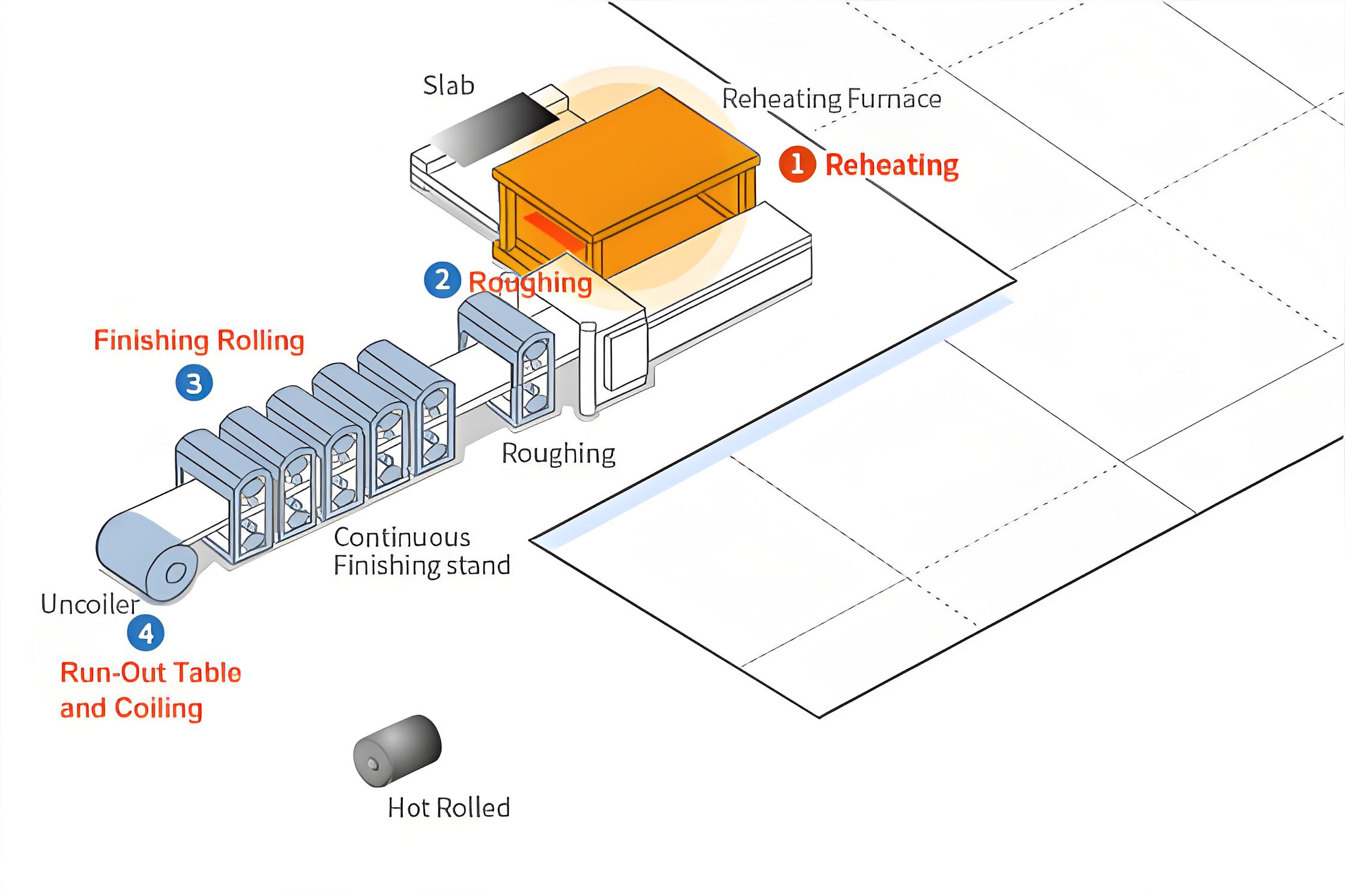
1. Reheating: Hot rolled coils pass through a pickling line, where scale breaker machines and hydrochloric acid solutions are used to remove any surface scale and/or oxide film that which causes surface flaws during the final stage of cold rolled steel processing.
2. Roughing: In this process, slabs whose surface scale share has been removed are made into rolled materials with the proper shape, thickness, and width. In the entry and exit area of the roughing mill, an edger rolls the strip in the width direction using an Automatic Width Control (AWC) system.
3. Finishing Rolling: The purpose of finishing rolling is to adjust the thickness and width of a coil to the specified dimensions and to produce a smooth surface and shape at the desired finishing temperature appropriate for its intended use. Our up-to-date equipment, including Work Roll Shift Mills, Pair Cross Mills and On-line Roll Grinders (ORG), enhances plant productivity and improves the quality of the finished coils by controlling the crown shape.
4. Run-Out Table and Coiling: Steel strips, after the finishing mill, are passed to the run-out table where they are coiled. While being rolled on the table, the strips are sprayed with water to cool them to the proper temperature for coiling.More Content Electrical steel
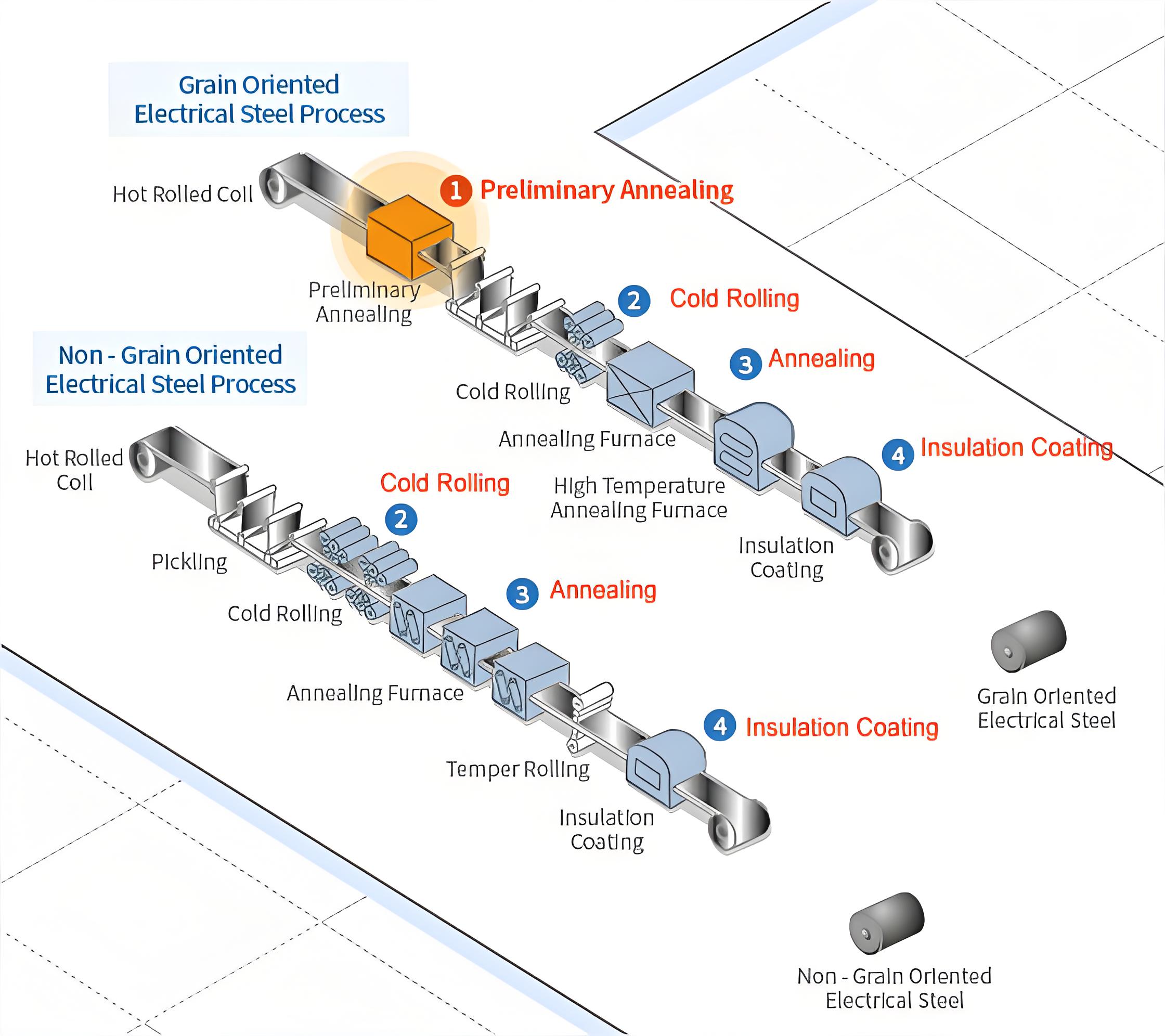
1. Preliminary Annealing: During the preliminary annealing process, a scale which may have formed on the hot rolled steel is removed as delayed passing through scale breaker and a hydrochloric acid bath. This initial heat treatment process improves the cold rolling properties of steel as well as its magnetic properties.
2. Cold Rolling: In order to obtain specific thickness and material properties, a reduction ratio of 40-90% is applied normally. Rolling and edge trimming machines are automatically controlled to obtain uniform thickness and width.
3. Annealing: Annealing is a process in which cold rolled structures are converted to a recrystallized structure through heat treatment. For grain oriented electrical steel, two different annealing methods are available: decarbonization annealing and high-temperature annealing. Decarbonization annealing removes excess carbon from the steel and applies a MgO coating. High-temperature annealing produces secondary recrystallized structures having superior magnetic properties.
4. Insulation Coating: In this process, insulation coating is applied by a continuous coater roll in order to minimize eddy current losses, which are proportional to the sheet thickness. A series of coaters are used to apply insulation coating liquid to the top and bottom of a plate. Grain oriented electrical steel has two layers of coating, a base coating of dark brown Forsterite (Mg2SiO4) as the main ingredient and a transparent insulating coating containing phosphates. For non-oriented electrical steel, various coating methods with various thicknesses and ingredients are used depending on end usage and specific user’s requirements.More Content
Related Posts
Online Message
Please give us a message